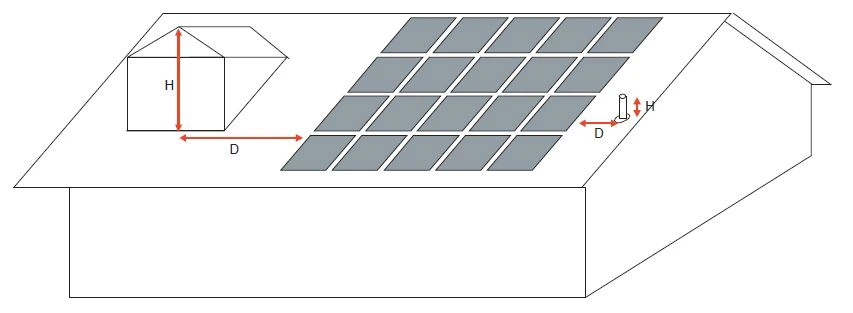
p.255(g) Any telephone or other utility pole that is closer than 30 feet from the nearest point
p.255of the array.
Text in this figure
Figure JA11-1: The Minimal Shading Criterion Artistic Depiction of "H" and "D"
p.255JA11.3.1 Prescriptive Minimum Shading Requirement
p.255If the PV system does not qualify for exception 1 of section 150.1(c)14, then the weighted average annual solar access by panel count shall be equal or greater than 98 percent.
p.255JA11.4 Solar Access Verification
p.255A certified solar assessment tool shall be used to demonstrate the shading condition of the actual installation of the PV module is consistent with compliance with JA11.3.1, the shading condition modeled in the performance method as indicated on the CF1R-PRF 01, and qualification to exceptions in 150.1(c)14.
p.255JA11.4.1 Solar Assessment Tool Certification Requirement
p.255Solar assessment tools shall be certified to the Executive Director according to the following requirements:
p.255a) The solar assessment tool shall calculate the annual solar access percentage of
p.255each individual solar array and a weighted average of the PV system as a whole. The calculation shall include all known obstructions, including any tree that is planted on the building lot or neighboring lots or planned to be planted as part of landscaping for the building.
p.255b) The solar assessment tool shall not include horizon shading in the calculation by
p.255default.
p.255c) The solar assessment tool shall produce a shade report with a summary of the PV
p.255system, including the address of the project, individual array panel count, orientation, annual solar access percentage, and a weighted average of the PV system as a whole.
p.255d) If the solar assessment tool model shading condition based on satellite or aerial
p.255images, the annual solar access percentage values shall be comparable to on-site measurements. Documentation shall be provided to CEC as proof.
p.255Appendix JA11 – Qualification Requirements for Photovoltaic System