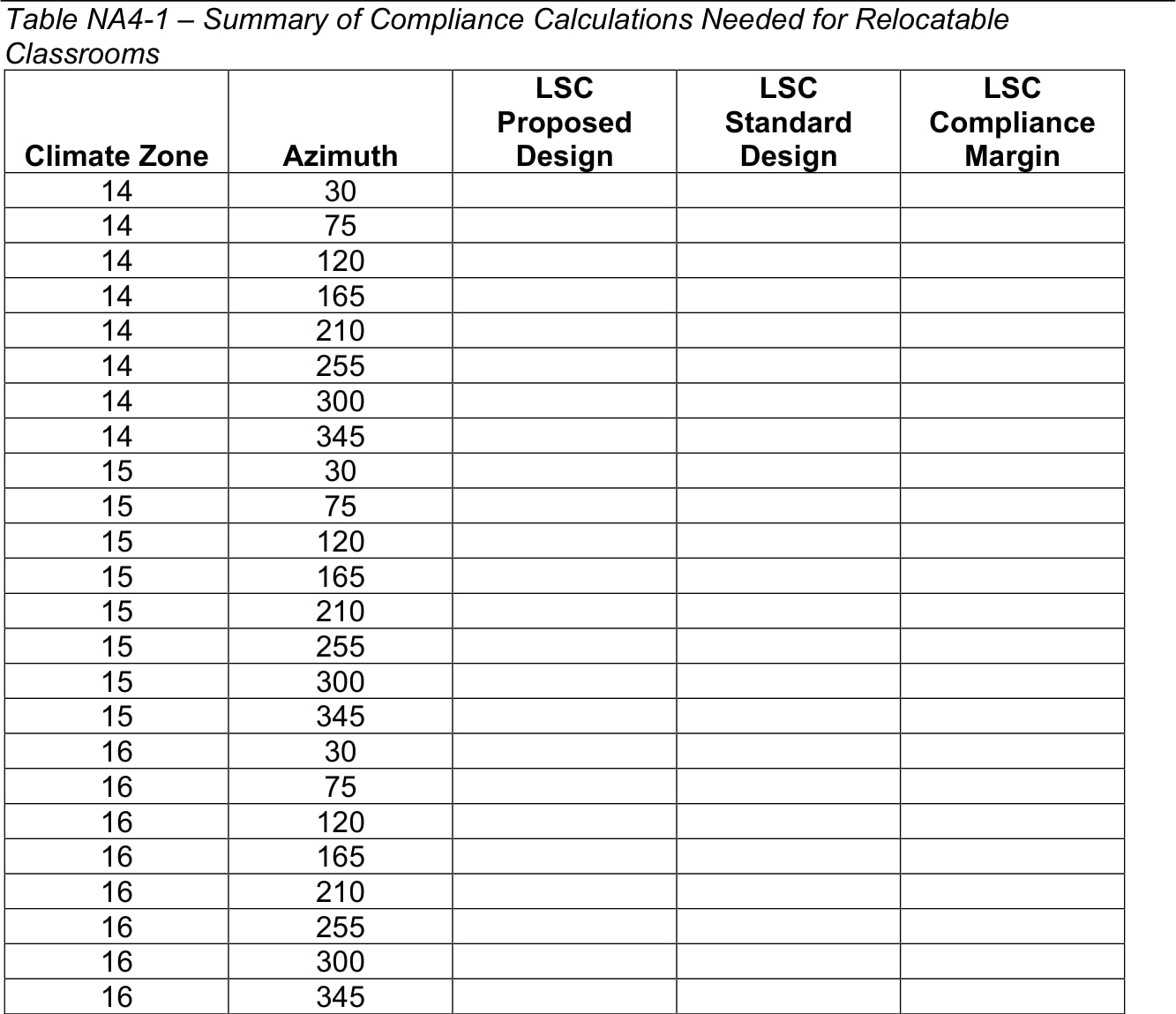
Text in this table
2025 Nonresidential Appendices Classrooms Climate Zone Azimuth LSC Proposed Design LSC Standard Design LSC Compliance Margin 14 30 14 75 14 120 14 165 14 210 14 255 14 300 14 345 15 30 15 75 15 120 15 165 15 210 15 255 15 300 15 345 16 30 16 75 16 120 16 165 16 210 16 255 16 300 16 345
| Order | Options Offered | States | |
|---|---|---|---|
| 1 | Efficient lighting option | Yes/No | |
| 2 | High efficiency heat pump | Yes/No | |
| 3 | Improved wall insulation | Yes/No | |
| 4 | Improved roof insulation | Yes/No | |
| 5 | Occupant sensor for lighting | Yes/No | |
| 6 | Low-e windows | Yes/No | |
| 7 | Skylights | Yes/No | |
| 8 | Daylighting Controls | Yes/No |
p.505(b) Windows that lower SHGC but increase U-factor, or vice versa.
p.505(c) Insulation options that reduce the U-factor for say walls, but increase it for the
p.505roof.
p.504Optional Features

p.505(d) Any other combination of measures that results in the performance of anyone
p.504Relocatable classrooms may come with a variety of optional features, like cars. A school district can buy the “basic model”, or it can pay for options. Many of the optional features do not affect energy efficiency and are not significant from the perspective of energy code compliance. Examples include floor finishes (various grades of carpet or tiles), casework, and ceiling and wall finishes. Other optional features do affect energy performance such as window construction, insulation, lighting systems, lighting controls, HVAC ductwork, HVAC equipment, and HVAC controls.
p.505measure being reduced in comparison to a complying basic model.
p.5052. Modeling of Every Combination Approach. A more complex whole building performance approach is required when a model is available with options which in combination may or may not comply. In this case every combination of options shall be modeled, and the specific combinations that comply shall be determined and only those combinations shall be allowed. This approach, while possible, requires considerably more effort on the part of the relocatable manufacturer and its energy consultant. It also places a greater burden on DSA when they issue the over-the-counter building permit for the PC design that only allows specific combinations of energy options. DSA would have to examine the specific optional features that are proposed with the over-the-counter application and make sure that the proposed combination of measures achieves compliance.
p.504When a manufacturer offers a relocatable classroom model with a variety of options, it is necessary to identify those options that affect energy performance and to show that the model complies with any combination of the optional features. Most of the time, optional energy features are upgrades that clearly improve performance. If the basic model complies with the Standards, then adding any or all of the optional features would
p.504Appendix NA4– Compliance Procedures for Relocatable Public School Buildingsp.505
p.505Appendix NA4– Compliance Procedures for Relocatable Public School Buildingsp.506
p.506Appendix NA4– Compliance Procedures for Relocatable Public School Buildings