p.41A. Recertification. The ATTCP shall recertify all ATEs prior to the implementation of each adopted update
p.42iii. Prequalification. Participation in the certification program shall be limited to persons who
p.43least five functional tests for which the ATT is certified. The shadow audit must replicate field conditions for installed equipment and controls in a building. The ATTCP training facility shall be setup to allow auditing of all functional tests for which the ATT is certified. The shadow audits must be in addition to any testing used for ATT recertification.
p.44i. The ATTCP shall record all certificates of compliance (Section 10-103(a)1), certificates of installation (Section 10-103(a)3), and certificates of acceptance (Section 10-103(a)4) associated with any acceptance test specified in Part 6, Section 120.5 and 160.3(d).
p.454. The Executive Director shall issue a written recommendation that the Energy Commission designate the applicant as an authorized ATTCP or deny the Provider application.
p.46(g) Review by the Energy Commission.
p.42have at least three years of professional experience and expertise in mechanical controls and systems as determined by the Mechanical ATTCPs.
Text in this table
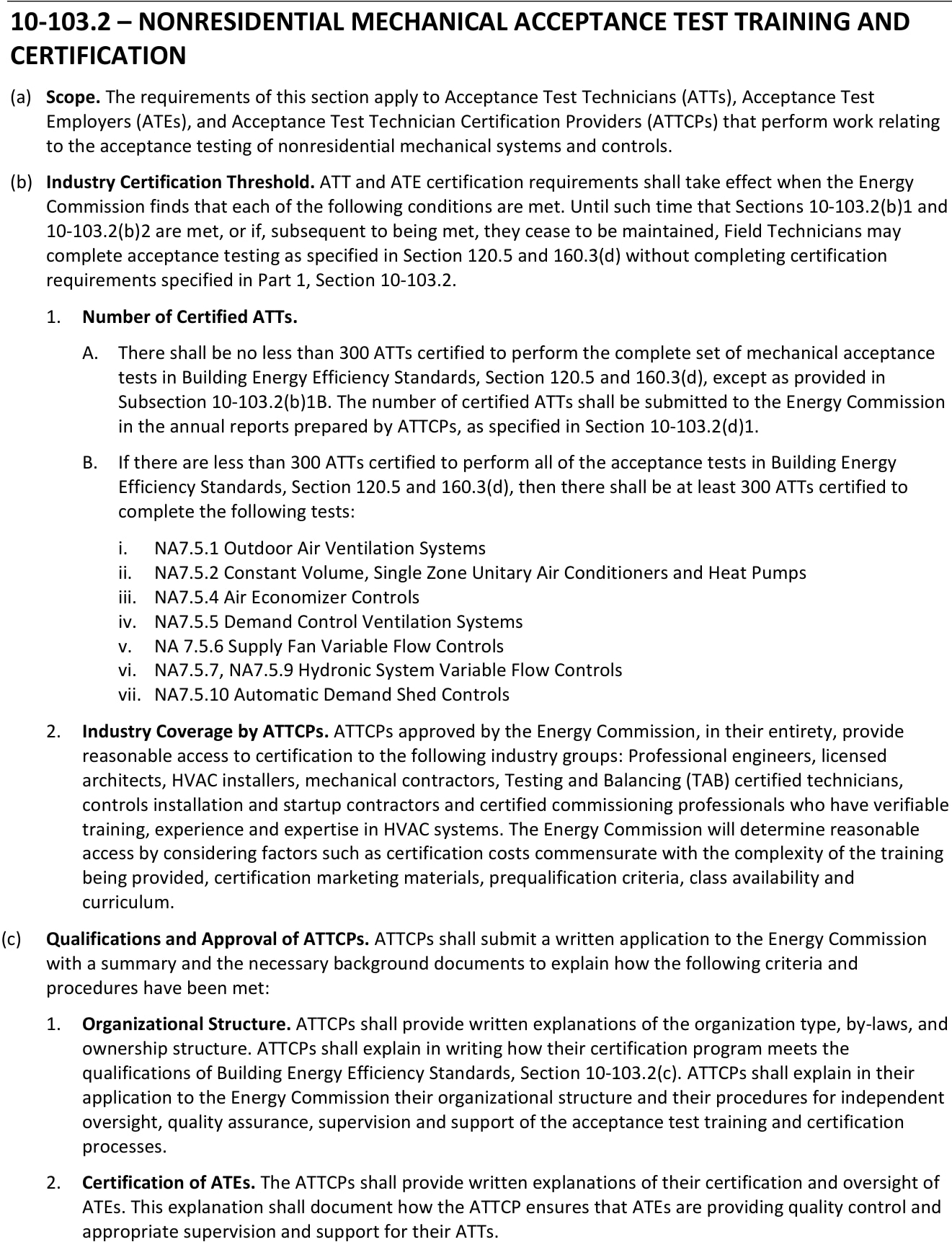
10-103.2 – NONRESIDENTIAL MECHANICAL ACCEPTANCE TEST TRAINING AND CERTIFICATION (a) Scope. The requirements of this section apply to Acceptance Test Technicians (ATTs), Acceptance Test Employers (ATEs), and Acceptance Test Technician Certification Providers (ATTCPs) that perform work relating to the acceptance testing of nonresidential mechanical systems and controls. (b) Industry Certification Threshold. ATT and ATE certification requirements shall take effect when the Energy Commission finds that each of the following conditions are met. Until such time that Sections 10-103.2(b)1 and 10-103.2(b)2 are met, or if, subsequent to being met, they cease to be maintained, Field Technicians may complete acceptance testing as specified in Section 120.5 and 160.3(d) without completing certification requirements specified in Part 1, Section 10-103.2. 1. Number of Certified ATTs. A. There shall be no less than 300 ATTs certified to perform the complete set of mechanical acceptance tests in Building Energy Efficiency Standards, Section 120.5 and 160.3(d), except as provided in Subsection 10-103.2(b)1B. The number of certified ATTs shall be submitted to the Energy Commission in the annual reports prepared by ATTCPs, as specified in Section 10-103.2(d)1. B. If there are less than 300 ATTs certified to perform all of the acceptance tests in Building Energy Efficiency Standards, Section 120.5 and 160.3(d), then there shall be at least 300 ATTs certified to complete the following tests: i. NA7.5.1 Outdoor Air Ventilation Systems ii. NA7.5.2 Constant Volume, Single Zone Unitary Air Conditioners and Heat Pumps iii. NA7.5.4 Air Economizer Controls iv. NA7.5.5 Demand Control Ventilation Systems v. NA 7.5.6 Supply Fan Variable Flow Controls vi. NA7.5.7, NA7.5.9 Hydronic System Variable Flow Controls vii. NA7.5.10 Automatic Demand Shed Controls 2. Industry Coverage by ATTCPs. ATTCPs approved by the Energy Commission, in their entirety, provide reasonable access to certification to the following industry groups: Professional engineers, licensed architects, HVAC installers, mechanical contractors, Testing and Balancing (TAB) certified technicians, controls installation and startup contractors and certified commissioning professionals who have verifiable training, experience and expertise in HVAC systems. The Energy Commission will determine reasonable access by considering factors such as certification costs commensurate with the complexity of the training being provided, certification marketing materials, prequalification criteria, class availability and curriculum. (c) Qualifications and Approval of ATTCPs. ATTCPs shall submit a written application to the Energy Commission with a summary and the necessary background documents to explain how the following criteria and procedures have been met: 1. Organizational Structure. ATTCPs shall provide written explanations of the organization type, by-laws, and ownership structure. ATTCPs shall explain in writing how their certification program meets the qualifications of Building Energy Efficiency Standards, Section 10-103.2(c). ATTCPs shall explain in their application to the Energy Commission their organizational structure and their procedures for independent oversight, quality assurance, supervision and support of the acceptance test training and certification processes. 2. Certification of ATEs. The ATTCPs shall provide written explanations of their certification and oversight of ATEs. This explanation shall document how the ATTCP ensures that ATEs are providing quality control and appropriate supervision and support for their ATTs.
p.42per code cycle where the ATTCP shall observe the performance of the ATT on atp.43
p.40CALIFORNIA CODE OF REGULATIONS TITLE 24, PART 1, CHAPTER 10, SECTION 103.2 – NONRESIDENTIAL MECHANICAL ACCEPTANCE TEST TRAINING AND CERTIFICATION
p.41CALIFORNIA CODE OF REGULATIONS TITLE 24, PART 1, CHAPTER 10, SECTION 103.2 – NONRESIDENTIAL MECHANICAL ACCEPTANCE TEST TRAINING AND CERTIFICATION
p.42CALIFORNIA CODE OF REGULATIONS TITLE 24, PART 1, CHAPTER 10, SECTION 103.2 – NONRESIDENTIAL MECHANICAL ACCEPTANCE TEST TRAINING AND CERTIFICATION
p.43CALIFORNIA CODE OF REGULATIONS TITLE 24, PART 1, CHAPTER 10, SECTION 103.2 – NONRESIDENTIAL MECHANICAL ACCEPTANCE TEST TRAINING AND CERTIFICATION
p.44CALIFORNIA CODE OF REGULATIONS TITLE 24, PART 1, CHAPTER 10, SECTION 103.2 – NONRESIDENTIAL MECHANICAL ACCEPTANCE TEST TRAINING AND CERTIFICATION
p.45CALIFORNIA CODE OF REGULATIONS TITLE 24, PART 1, CHAPTER 10, SECTION 103.2 – NONRESIDENTIAL MECHANICAL ACCEPTANCE TEST TRAINING AND CERTIFICATION
p.46CALIFORNIA CODE OF REGULATIONS TITLE 24, PART 1, CHAPTER 10, SECTION 103.2 – NONRESIDENTIAL MECHANICAL ACCEPTANCE TEST TRAINING AND CERTIFICATION